
Your Next Audit Just Changed: FSSC 22000 V7’s Upgrade Process in Malaysia
FSSC 22000 Version 7 does not require already-certified sites in Malaysia to restart certification from scratch; instead, the move from Version 6 to Version 7 happens through your next scheduled surveillance or recertification audit. This guide explains exactly how that upgrade audit process works for Malaysian food businesses, what an auditor will be checking that is new, and how to prepare before that visit arrives.
Key Changes at a Glance
- Already-certified sites move to Version 7 via their next scheduled audit, not a brand-new certification cycle.
- Both surveillance and recertification audits can be the vehicle for the Version 6 to Version 7 upgrade.
- Auditors will assess updated PRP references, sustainability clauses, and AI governance during that same visit.
- Auditor qualification for the visit itself is now aligned with GFSI Benchmarking Requirements version 2024.
- Version 6 certificates remain valid and auditable in Malaysia throughout the official transition window.
- FSSC has published a transition timeline; confirm your exact upgrade-audit date with your certification body.
- Preparing PRP documentation and internal audit training ahead of the visit avoids a rushed audit day.
How the FSSC 22000 Version 6 to Version 7 Upgrade Audit Works
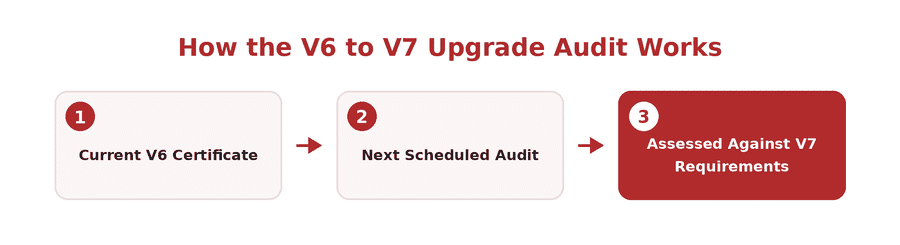
For a Malaysian food business already certified to FSSC 22000 Version 6, the path to Version 7 is built into the audit cycle you already follow. Rather than requiring a new initial certification audit, the scheme moves already-certified sites to Version 7 through their next scheduled surveillance or recertification audit — whichever comes next on your certification calendar. At that visit, the assigned auditor assesses your site against the Version 7 requirements rather than Version 6, and if your management system, PRP documentation and records demonstrate conformance, your certificate is upgraded as part of that same audit.
This matters practically because it means Malaysian certified organisations do not need to schedule an additional, separate audit purely to move from Version 6 to Version 7. It also means the upgrade is not automatic or paperwork-only: the auditor is genuinely assessing conformance to the new requirements, which is why preparation before the visit — not just awareness that a transition exists — determines how smoothly that audit goes.
Because the specific requirements being assessed have changed, organisations should also expect the audit itself to look a little different from a routine Version 6 surveillance visit, even if the overall format and duration follow familiar patterns.
What the Auditor Will Actually Be Checking Under Version 7
At your upgrade audit, expect the auditor to check your PRP documentation against the newer ISO 22002-x:2025 series of sector standards rather than the ISO/TS 22002-x series referenced under Version 6, so any hygiene, sanitation, pest control or facility-related procedures should already be mapped to the updated references before the visit. The auditor themselves will also be qualified under the GFSI Benchmarking Requirements version 2024-aligned competence rules that Version 7 introduces, and Version 7’s more clearly defined food chain category and sub-category structure should mean that auditor is specifically matched to your site’s scope.
Beyond PRP and competence matching, expect questions about the newer subject-matter requirements Version 7 introduces: Food Loss & Waste management practices, any “Save Food Packaging” design-principle considerations relevant to your packaging decisions, and — if your organisation uses AI in any certification-related activity — evidence of an ethical, fair and compliant governance framework covering that use.
None of this replaces the core ISO 22000 food safety management system elements the auditor has always assessed; it adds to them. Organisations that treat the upgrade audit as “the same visit, plus a defined set of new things to show evidence for” tend to prepare more effectively than those expecting an entirely different audit experience.
How Malaysian Certified Organisations Should Prepare Before the Visit
Start by confirming with your certification body whether your next scheduled audit — surveillance or recertification — is the one that will deliver your Version 7 upgrade, and get clarity on the exact timing rather than relying on general transition timeline commentary. FSSC has published a formal transition timeline, but cascade dates vary, so your certification body is the authoritative source for what applies to your specific certificate.
With that date confirmed, work backward: review and update PRP documentation against ISO 22002-x:2025, brief your internal audit and quality teams on the new requirements, and put Food Loss & Waste and AI governance procedures in writing if they are not already documented. Malaysian food manufacturers exporting to markets that specifically track FSSC 22000 status should also make sure supply chain partners understand that a Version 6 certificate remaining valid during this period is expected and normal, not a compliance gap.
Building in a short internal readiness review a few weeks ahead of the scheduled audit — essentially a dry run against the Version 7 requirements — is one of the most effective ways to catch documentation gaps before the actual upgrade audit, when there is still time to fix them. Assigning a single internal owner to track PRP updates, sustainability documentation, and AI governance procedures in the run-up to the audit also helps avoid last-minute gaps falling between departments that each assumed another team was responsible.
Common Misconceptions About the Upgrade Audit
A frequent misconception among Malaysian certified organisations is that moving from Version 6 to Version 7 requires an entirely separate certification project, complete with a new initial audit. It does not — the upgrade rides on your existing scheduled audit cycle. Another common mistake is assuming the upgrade audit will simply confirm what a Version 6 audit already covered with a few extra questions tacked on; in reality, PRP references, auditor qualification basis, and several substantive new requirements are genuinely different, and unprepared organisations can be caught out by nonconformities in areas like Food Loss & Waste or AI governance simply because no one owned those topics before the visit.
A third misconception is that because Version 6 remains valid during the transition, there is no real deadline pressure. There is still a deadline that matters to your organisation specifically: your own next scheduled audit date. Treating that date as the real, binding deadline — rather than waiting for a scheme-wide cutover — is the more accurate way to think about urgency.
A fourth misconception, common among Malaysian organisations with multiple certificates or multiple sites under one certification body relationship, is assuming the upgrade audit process is identical everywhere in the group. Scope, sub-category, and even which surveillance year a given site is in can all affect exactly what an individual upgrade audit covers, so it is worth confirming details site by site rather than assuming uniform treatment across a multi-site portfolio.
How IAS Malaysia Prepares Your Team for the Upgrade Audit
Because the upgrade audit assesses updated PRP references, new sustainability and AI governance requirements, and relies on an auditor qualified under GFSI 2024-aligned competence rules, the organisations that come through it smoothly are the ones whose own internal teams already understand those same requirements. IAS Malaysia supports certified organisations with FSSC 22000-focused training built specifically around the Version 7 scheme and what an upgrade audit will assess.
If your next scheduled surveillance or recertification audit is approaching, we recommend you explore our FSSC 22000 Lead Auditor and Internal Auditor Training programmes so your internal audit and quality teams walk into that visit prepared rather than surprised. And for a broader look at every Version 7 change beyond the upgrade audit process itself, our complete FSSC 22000 Version 7 guide covers the PRP, auditor qualification, sustainability and transition-timeline topics in full.
FSSC 22000 Version 6 vs Version 7: Upgrade Audit Process at a Glance
| Aspect | Version 6 | Version 7 |
|---|---|---|
| Audit type required for upgrade | N/A | Next scheduled surveillance or recertification audit |
| Separate initial certification needed | N/A | Not required for already-certified sites |
| PRP references assessed | ISO/TS 22002-x series | ISO 22002-x:2025 series |
| Auditor competence basis for the visit | Prior GFSI Benchmarking Requirements | GFSI Benchmarking Requirements version 2024 |
| New topics assessed at the same visit | Not applicable under Version 6 | Food Loss & Waste, Save Food Packaging, AI governance |
| Certificate status while awaiting upgrade audit | Valid and auditable | Remains valid and auditable |
Note: exact FSSC 22000 Version 6 to Version 7 transition/cascade dates should be confirmed directly with your certification body.
About the author
Adekoya Oluwatosin is a food safety consultant, trainer and FSSC 22000 v6 Lead Auditor with over eight years of hands-on experience across food manufacturing, packaging, storage & distribution and catering. She has personally conducted more than 22 internal audits — including FSSC 22000 and ISO 9001:2015 audits — and led FSMS/QMS implementation projects that guided over ten organisations to certification.
Frequently Asked Questions
How do certified sites in Malaysia upgrade from FSSC 22000 Version 6 to Version 7?
Through their next scheduled surveillance or recertification audit, where the assigned auditor assesses the site against the Version 7 requirements rather than a separate new certification process.
What does the upgrade audit check that a normal Version 6 audit did not?
It checks PRP documentation against the updated ISO 22002-x:2025 references and adds new topics such as Food Loss & Waste management, Save Food Packaging design principles, and AI governance where applicable.
Is a new initial certification audit needed to move to Version 7?
No. Already-certified sites are upgraded through their existing scheduled audit cycle rather than a brand-new initial certification audit.
Will our FSSC 22000 Version 6 certificate still be valid before the upgrade audit?
Yes. Version 6 certificates remain valid and auditable during the official transition window while you wait for your scheduled upgrade audit.
How should a Malaysian food business prepare for the upgrade audit?
Confirm the exact timing with your certification body, update PRP documentation to the ISO 22002-x:2025 series, and document Food Loss & Waste and AI governance procedures before the scheduled visit.

