
cGMP Internal Auditor Training in Malaysia
The difference between an internal audit that finds something and one that does not is usually decided before anyone walks onto the floor. It is decided in the checklist.
cGMP internal auditor training teaches staff to audit their own manufacturing operation against current Good Manufacturing Practice requirements. A large part of the course turns requirements into questions specific enough to force evidence into the open. A checklist that asks “is documentation controlled?” produces a yes. A checklist that asks the auditor to compare the SOP at the workstation against the current version in the register produces a finding or a genuine clearance. Same requirement, entirely different audit.

What cGMP Internal Auditor Training Delivers
Participants learn to audit the organisation that employs them, measuring practice against GMP and cGMP requirements and against the procedures the company has written for itself.
cGMP puts weight on the word current: a quality system is expected to describe how the plant runs today. Checklists are where that principle becomes operational, because a checklist written from last year’s process will confirm last year’s process and miss everything that has changed since.
Where a company wants the site assessed by an outside body instead, that route is set out on the cGMP certification in Malaysia page.
Anatomy of a Checklist Item
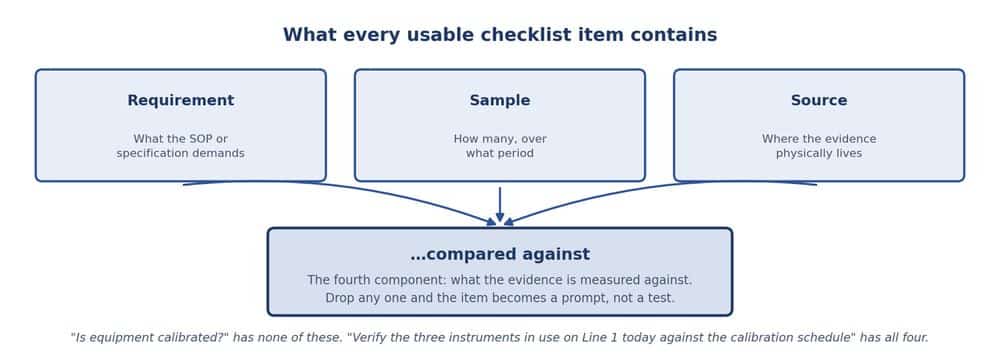
Every usable checklist item contains the same four components. Drop any one of them and the item becomes a prompt rather than a test.
- The requirement anchors the question to something agreed — an SOP clause, a specification, a batch documentation rule.
- The sample names how much will be examined, which is what stops an auditor checking one record and declaring the area sound.
- The source names where the evidence lives, so the auditor knows what to request rather than asking vaguely for “the paperwork”.
- The comparison states what the evidence is measured against, which is what converts a look into a test.
Weak Items and Their Replacements
| Weak item | Rebuilt item | What the rebuild adds |
|---|---|---|
| Is the area clean? | Compare the cleaning record for Line 3 over the last two weeks against the cleaning frequency in SOP-PR-018 | A defined period and a documented standard |
| Are deviations closed? | For the three most recent closed deviations, identify the evidence used to confirm the corrective action worked | Tests closure quality rather than closure count |
| Is material traceable? | Trace one released finished batch back to the receipt and release record of every component lot | A single end-to-end test that exposes any break in the chain |
| Is the warehouse organised? | Confirm the status labels on five quarantined pallets match the system status and the release records | Named sample, named source, named comparison |
| Are records complete? | For four batch records from different weeks, check that entry times are consistent with the production schedule | Tests when entries were made, not just whether boxes are filled |
The rebuilt versions take longer to write and far less time to argue about afterwards.
Building the Checklist From the Criteria
The training works through the sequence in a practical order rather than a theoretical one.
Start from the criteria
Work from the applicable GMP and cGMP requirements, the quality manual, the SOPs relevant to the area, and any customer commitments. Read the previous audit report and the open corrective actions, because anything unresolved deserves a checklist item of its own. Then write the items, one per requirement worth testing, each naming its sample, source and comparison.
Size the checklist to the time available
An auditor with a half day and forty items will do forty things badly. Twelve items examined properly produce a better audit and a defensible report. Where the scope genuinely needs forty items, the honest response is to split the audit or extend it, not to skim.
Leave room for what the audit turns up
A rigid checklist worked through mechanically misses the follow-up questions that produce the real findings, so experienced auditors treat it as a floor rather than a ceiling.
What the Auditor Does With It
On the day, the checklist becomes a sequence of requests. The auditor asks for the named records, examines them, watches the corresponding activity, and asks the person performing it to explain what they do. Each item is closed out with a note carrying references — document numbers and revisions, batch numbers, equipment identifiers, dates.
Where an item produces an exception, the auditor widens the sample immediately rather than moving on. One lapse is a slip; the same lapse across the period is a control that has stopped working, and only the wider sample distinguishes them.
Findings are written as requirement, evidence, then gap — no adjectives, no individuals named.
A Worked Example: Three Items for a Packaging Area
It helps to see the method applied. Suppose the audit covers packaging on a line running two similar products, and the criteria include the packaging SOP series, the batch documentation rules and a customer specification requiring lot coding.
Item one: mix-up prevention
“Take the two most recent changeovers between Product A and Product B. For each, confirm a line clearance record exists, and that it was signed before the first entry on the incoming batch record. Confirm also that reconciliation of removed components was completed.” That item names the sample, the source and three separate comparisons. It tests the control that actually prevents a mix-up.
Item two: coding accuracy
“For one batch of each product, compare the lot code and expiry printed on retained samples against the batch record and the customer specification.” Retained samples are physical evidence that cannot be reconstructed afterwards, which makes them unusually strong.
Item three: material reconciliation
“For three batches across the last quarter, compare printed component issued, used, rejected and returned against the reconciliation on the batch record. Identify how any variance was explained.” Reconciliations that always balance exactly are worth widening around.
Three items, perhaps ninety minutes of work, and between them they test mix-up prevention, coding accuracy and material accountability — the three things a customer auditor will ask about first. Compare that with a checklist reading “Is the packaging area controlled? Are records complete? Is reconciliation performed?”, which could be answered yes in four minutes and would prove nothing at all.
The exercise also shows why checklists are worth keeping. Next cycle, these three items are the starting point; the auditor updates the SOP references, changes the sample period, and adds an item for anything the previous audit left open.
Who cGMP Internal Auditor Training Suits
| Attending as | Why the checklist focus matters to them |
|---|---|
| QA staff running the audit programme | The checklist is the main artefact they produce and reuse |
| Production and packaging supervisors | See what will be tested and how, which changes how records are kept |
| QC and laboratory personnel | Laboratory checklists need method-specific items, not generic ones |
| Engineering and calibration staff | Equipment items must name instruments and due dates to be useful |
| Warehouse and materials teams | Traceability is best tested by a single end-to-end checklist item |
| Compliance staff | Translate requirements into testable questions rather than restating them |
| Contract manufacturers | Client auditors arrive with their own checklists; knowing the format helps |
No previous audit experience is required. Those already working inside a GMP system write better checklists sooner, because they know where the records actually live. Employees coming to manufacturing quality fresh are usually steered toward a cGMP foundation course first.

Capabilities Built
- Reading criteria and identifying which requirements are genuinely testable
- Writing items that name requirement, sample, source and comparison
- Sizing a checklist to the hours actually available
- Building traceability items that test an entire chain in one exercise
- Reusing and updating checklists as processes change
- Leaving room to follow what the audit uncovers
- Recording referenced evidence against each item as you go
- Widening a sample when an item produces an exception
- Wording findings so the checklist item and the finding line up
- Reviewing whether a corrective action would satisfy the same item next time
The same method underpins every course in the ISO internal auditor training range IAS runs, so auditors who later work to a different standard are not starting from scratch.
What Manufacturers Get From It
A good checklist outlives the audit. It becomes the starting point for the next cycle, a training aid for new auditors, and a reference for the area being audited. Several manufacturers issue the checklist in advance precisely so that the area can prepare. Their reasoning is that a site which prepares properly has already fixed half of what would otherwise have been found.
The commercial payoff is the same one every functioning audit programme delivers: fewer surprises when a customer arrives, because the same questions have already been asked internally and answered from records.
Training and Certification Are Two Different Things
| Question | Internal auditor training | cGMP certification |
|---|---|---|
| What is being developed or assessed? | A person’s ability to audit | An organisation’s manufacturing control |
| Who carries it out? | Trained employees, internally | An independent certification body |
| What exists at the end? | A trained auditor and a training record | A certificate for a defined scope |
| How often? | As often as the audit programme requires | Initial assessment, then a surveillance cycle |
Neither substitutes for the other. Certified companies still audit themselves; trained auditors do not make a company certified. Auditors who go on to lead external or supplier audits usually progress to ISO lead auditor training in Malaysia.
cGMP Internal Auditor Training in Malaysia: Course Details
How long cGMP Internal Auditor Training in Malaysia runs depends on the number of participants and the route chosen, and the fees are set out in the same written quotation. Everyone finishing this cGMP internal auditor course receives a certificate of completion showing the syllabus and date for your training records. Report writing is covered: wording a finding so it holds up against the checklist item, and tracing a recurring problem to its root cause without naming anyone.
Objective
Enable participants to plan, conduct, report and follow up internal audits of GMP and cGMP quality systems, with particular strength in checklist construction.
Coverage
GMP and cGMP fundamentals; criteria and scope; checklist design; sampling; record review; observation and interviewing; objective evidence; nonconformity classification; findings and reporting; corrective-action review and verification; auditor conduct and independence.
Outcomes
Participants should be able to build a checklist from a criteria set, conduct an audit against it, record referenced evidence, raise and word nonconformities, produce a report and evaluate corrective actions.
Formats
Delivered in-house, in the classroom, live online, or self-paced online. Checklist writing benefits from working on real procedures, which in-house delivery allows; where that is not practical, online cGMP internal auditor training and virtual cGMP training cover the same syllabus, detailed on the IAS GMP internal auditor training page.
Tell us the site, your product categories and how many people need training, or call +60 3-2201 5087. On what is being offered: IAS trains auditors and certifies management systems, while licensing a facility and approving a product are decisions only regulators make.
Frequently Asked Questions
What makes a checklist item useful rather than decorative?
Four things: it names the requirement being tested, how much will be sampled, where the evidence sits, and what the evidence is compared against. Items missing any of these tend to produce yes-or-no answers that prove nothing. “Is calibration controlled?” fails all four. “Verify the calibration status of the three instruments in use on Line 1 today against the calibration schedule” passes all four.
Can we reuse the same checklist every year?
Reuse it as a starting point, but never unchanged. Processes, equipment and procedures move, and a checklist written against last year’s process will quietly confirm last year’s process. Each cycle it should be updated against current SOPs, and items added for anything the previous audit left open.
Should the checklist be shared with the area before the audit?
Many companies do, and there is a reasonable argument for it. A site that prepares has usually corrected some of what would have been found, which is the point of the exercise. The counter-argument is that advance notice permits tidying rather than fixing, which is why observation and record sampling still matter regardless of what was shared.
What if the audit uncovers something the checklist did not anticipate?
Follow it. The checklist sets a minimum, not a boundary. Mechanically working through a list while ignoring what is visible in front of you is a common failing among newly trained auditors, and it is the reason experienced auditors deliberately leave time unallocated.
How do you write a checklist item for traceability?
As a single end-to-end test rather than several fragments. Take one released finished batch and trace it back to the receipt and release status of each component lot. A break anywhere in the chain appears immediately, and the exercise tests receipt, storage, release and batch documentation simultaneously.
Who should write the checklist — the auditor or the quality manager?
The auditor who will use it, working from the criteria and the previous report. Checklists handed down from someone who will not be in the room tend to be generic. An auditor working through someone else’s list rarely knows why an item is there, or what would count as a satisfactory answer.
Does the same approach work for auditing suppliers?
Yes, with the criteria adjusted. Second-party checklists draw on your supply agreement and specifications as well as GMP requirements, and the sample sizes are usually smaller because access is more limited. The structure — requirement, sample, source, comparison — does not change.
How does the checklist relate to the audit report?
Directly. Each item either closes out satisfactorily or produces a finding, and the referenced notes taken against each item become the evidence in the report. Auditors who record against the checklist as they go write reports quickly; those who rely on memory afterwards write vague ones.

