cGMP Certification in Malaysia
Independent third-party cGMP certification for Malaysian manufacturers and exporters, scoped to what you actually make, audited against the scheme that applies to it, and priced in a written quotation before work starts. Pharmaceuticals, halal food, palm-oil-derived cosmetics, medical devices, or another product category entirely — IAS scopes the audit to fit.
Ready to scope your certification? Outline your production lines and receive a fixed written quotation — contact IAS today.
cGMP Certification in Malaysia at a Glance
- Scope: fixed to the scheme covering your product category — a single generic checklist is never used.
- Eligible industries: pharmaceuticals, halal food and beverage ingredients, palm-oil-derived cosmetics, medical devices, nutraceuticals, and any other manufactured product category.
- Certification cycle: initial assessment, certificate issued, surveillance annually, then recertification.
- Pricing: quoted once, in writing, after your scope is agreed. There is no published price list.
- Accreditation: IAS holds UQAS accreditation covering this certification.

Why Global Buyers Expect cGMP Certification from Malaysian Suppliers
Malaysia’s manufacturing base runs from Penang’s medical device and electronics clusters to palm-oil-derived cosmetics, halal food ingredients and nutraceutical contract manufacturing in Selangor and Johor. It sells heavily into export markets, and buyers there run their own supplier due-diligence programmes before placing an order.
The gap certification closes
A cGMP certificate is a portable, third-party-verified record of process control that a buyer’s quality team can check without commissioning its own audit for every shipment or contract renewal.
Where the commercial upside sits
Some companies compete for OEM and ODM contracts, private-label supply deals, or shelf space with international retailers. For them, that record often shortens supplier qualification. It also reduces the number of buyer-led audits a factory has to host.
Why cGMP is not one universal standard
cGMP is a shorthand term describing good-manufacturing-practice expectations. These appear, in different forms, across US FDA 21 CFR regulations (US market only), WHO GMP guidelines, the PIC/S GMP guide, ISO 22716 for cosmetics, and Malaysia’s own NPRA framework. An IAS certificate always states, on its face, the specific scheme and scope it was issued against — never a generic, unscoped claim. A certificate that clearly states its scheme, scope and site coverage tends to move a supplier through buyer qualification faster than a vague one.
cGMP Meaning: What Sets It Apart from Standard GMP
cGMP, or current Good Manufacturing Practice, refers to GMP requirements interpreted against the most up-to-date methods, technology and risk-control expectations recognised at the time of assessment — not a fixed, unchanging checklist.
- Plain GMP: the foundational principles — quality management, hygienic design, traceability, defined procedures.
- The “current” in cGMP: signals that a manufacturer’s systems are expected to reflect present-day risk-based practice, not a static baseline set years earlier. Buyers often use the two terms interchangeably, but the distinction matters when a certification scope, audit checklist or regulatory submission is on the table.
- Keep the three apart: GMP, NPRA’s own licensing framework and a voluntary cGMP certificate are not interchangeable. Confusing an NPRA licence with an IAS certificate in a buyer conversation risks overstating a facility’s credentials — exactly what a well-run due-diligence process is meant to catch.
GMP vs cGMP and the NPRA Licence Compared
The table below sets out how these three reference points typically differ.
| Reference point | What it is | Who issues or recognises it |
|---|---|---|
| GMP (general) | Foundational good-manufacturing-practice principles referenced across most GMP-based schemes | Not a certificate itself — a set of underlying principles |
| cGMP | GMP interpreted against current, up-to-date risk-based practice for the applicable scheme and scope | Certified by an independent body such as IAS, against a stated scheme |
| NPRA GMP licence | Malaysia’s own regulatory licensing requirement for pharmaceutical manufacturers | Issued and inspected directly by NPRA — not a third-party certificate |
Mapping the Oversight: NPRA, the Ministry of Health, WHO, US FDA and IAS
A buyer doing supplier due diligence on a Malaysian facility usually needs to understand who actually oversees what, because the answer determines which document proves which claim.
| Buyer’s due-diligence question | Body responsible | What it confirms |
|---|---|---|
| Is this pharmaceutical manufacturer licensed to operate in Malaysia? | NPRA (National Pharmaceutical Regulatory Agency, Ministry of Health Malaysia) | Licenses pharmaceutical manufacturers and products, and conducts its own GMP inspections for licensing purposes |
| Is this food premises regulated and inspected in Malaysia? | Ministry of Health Malaysia — Food Safety and Quality Division | Regulates and inspects food premises under Malaysian food safety law |
| Does this factory meet an internationally referenced GMP guideline? | WHO | Publishes GMP guidelines as a global reference — WHO does not regulate or certify any facility directly |
| Does this supplier meet US pharmaceutical requirements? | US FDA | Regulates only the US market — issues no certificates through IAS or any other third party, and has no jurisdiction over Malaysian domestic operations |
| Has this facility’s process control been independently verified? | IAS | Issues independent third-party cGMP certification under its UQAS accreditation, against a stated scheme and scope |
- Not FDA approval. An IAS cGMP certificate is never presented, marketed or interpreted as FDA approval, registration or clearance. Manufacturers targeting the US market can pair certification with IAS’s FDA certification in Malaysia service.
- Not a substitute for NPRA or MoH requirements. Certification is never a replacement for an NPRA licence, a Ministry of Health food premises approval, or any other regulatory obligation — it complements these requirements, it does not substitute for them.
- IAS’s role. IAS provides certification services under its UQAS accreditation — see accreditation and association.
Not sure which scheme applies to your products? Ask IAS for a free scoping conversation before you commit to anything.
What a cGMP Audit Typically Covers
Because cGMP certification is issued against a specific scheme and product scope rather than one universal checklist, exact audit content varies by industry and scheme. Buyers evaluating a Malaysian supplier’s readiness commonly expect the audit to look at areas such as:
- Facility layout and contamination control — hygienic design and control of contamination or cross-contamination risk.
- Quality management system — structure, management responsibility and internal review.
- Documentation practices — as applicable to the scheme and product category: SOPs, batch or production records, and change control.
- Equipment — qualification, calibration and planned maintenance records.
- Raw material and supplier control — incoming inspection and traceability.
- Personnel — training, hygiene practices and competency records.
- CAPA — corrective and preventive action handling for nonconformities and complaints.
- Data integrity — record-keeping practices appropriate to the certification scope.
None of these are universally mandatory. Each applies as relevant to the applicable GMP or cGMP scheme and product category, and the auditor scopes the checklist accordingly before the on-site visit. Manufacturers that want their own staff able to run the same checks internally usually pair certification with cGMP internal auditor training in Malaysia.
One Term, Many Rulebooks: Why Product Category Changes the cGMP Requirements
Food, cosmetics, pharmaceuticals and medical devices do not follow one identical cGMP framework. A halal food ingredient exporter, a palm-oil-based cosmetics formulator and a pharmaceutical contract manufacturer may sit in the same industrial park and still work to entirely different GMP guidelines. All three will describe their certificate with the same “cGMP” shorthand.
| Product category | Commonly referenced frameworks |
|---|---|
| Pharmaceuticals and active ingredients | WHO GMP guidelines, PIC/S GMP guide principles, or NPRA’s own licensing framework |
| Cosmetics and personal care, including palm-oil-derived formulations | ISO 22716 |
| Food and food ingredients | Codex-aligned GMP principles and Malaysian food safety requirements administered by the Ministry of Health |
| Medical devices | ISO 13485-aligned quality system requirements |
| Dietary supplements and nutraceuticals | Product-specific GMP guidance depending on export destination |
Certification is open well beyond these four categories. Packaging converters, chemical formulators and animal feed producers can all apply, as can warehousing and logistics operators and contract packing businesses. The audit is scoped to their own products and processes. Certification against ISO frameworks is available through the ISO certification in Malaysia hub.

cGMP Certification in Malaysia: Which Industries Pursue It
Demand for independent cGMP certification in Malaysia tends to cluster around industries with heavy export exposure or multinational buyer relationships:
| Industry | Typical driver |
|---|---|
| Pharmaceutical and API manufacturers | Supplying regional and export markets |
| Halal-certified food and beverage ingredient processors | Exporting into Gulf and other international markets |
| Palm-oil-derived cosmetics, personal care and oleochemical manufacturers | Brand-owner due diligence on formulation control |
| Nutraceutical and dietary supplement contract manufacturers (OEM/ODM) | Fast-growing export category with buyer-driven requirements |
| Medical device and diagnostic component manufacturers | Penang’s electronics-adjacent supply chain, global OEM qualification |
| Contract packing, private-label and toll manufacturing operators | Serving multinational brand owners |
| Animal feed, packaging and chemical formulation businesses | Supplying regulated downstream customers |
What ties these industries together is not a shared product category but a shared commercial reality. Each sells into supply chains where the buyer sits at a distance and cannot rely on personal familiarity with a supplier’s operations. Malaysia’s manufacturing sector is diversifying beyond its traditional electronics and palm-oil base into higher-value processed food, personal care and healthcare-adjacent manufacturing. As it does, more facilities are finding that an export contract or distribution agreement now comes with an explicit certification expectation attached.
See where your products fit? A scoping call carries no obligation and ends with a written quotation, not an invoice.
cGMP Certification in Malaysia: The IAS Assessment Journey
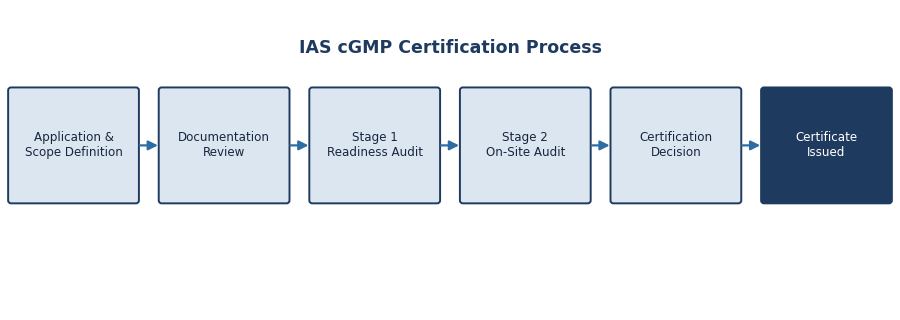
IAS structures cGMP certification as a defined sequence rather than a single inspection visit, so both the manufacturer and the eventual buyer reviewing the certificate understand exactly what was assessed. The general IAS certification process is described on its own page, as is the cGMP certification audit procedure.
- Application and scope definition — the manufacturer submits an application identifying the applicable GMP or cGMP scheme, product category and site or sites to be covered.
- Documentation review — IAS reviews the quality manual, procedures and supporting records relevant to the defined scope, as applicable to the scheme and product category.
- Stage 1 readiness audit — an initial review confirms the management system is sufficiently developed and ready for on-site assessment.
- Stage 2 on-site audit — auditors assess the facility against the areas typically covered by the applicable scheme, verifying that documented practice matches actual operation.
- Certification decision — findings are reviewed independently of the audit team before a certification decision is made.
- Certificate issued — IAS issues the certificate stating the specific scheme, scope and site or sites covered.
What Shapes Your Timeline and Investment
GMP certification cost in Malaysia cannot be stated as a fixed number, and neither can the timeline, because both depend on facility-specific factors rather than a flat industry rate.
| Cost driver | Why it matters |
|---|---|
| Number of sites in scope | Each additional manufacturing or storage site within the certification scope adds audit time |
| Product family breadth | A facility running multiple product families, for example both food ingredients and packaging, may need a broader audit scope than a single-line operation |
| Existing documentation maturity | Facilities with well-established SOPs, batch records and CAPA systems typically need less preparation support before the audit |
| Applicable scheme complexity | A pharmaceutical GMP scheme generally involves more extensive review than a lower-risk product category |
| Corrective action follow-up | Nonconformities raised during audit that require a follow-up visit add to the overall engagement |
- Timeline drivers: facility readiness, the number of sites and product families in scope, and how quickly corrective actions — if any are raised — can be closed out.
- The IAS commitment: a fixed written quotation reflecting these factors before any audit date is committed to, with no open-ended or variable fees once that quotation is accepted.
A buyer reviewing a supplier’s certification rarely asks what it cost. The question is whether the certificate came from a genuinely independent audit against a clearly stated scope. A fixed, transparent quotation process exists to support that distinction.
Want a real number rather than a range? Send us your sites and product categories and we will quote in writing.
Keeping Your Certificate Active: The Ongoing Cycle
cGMP certification is not a one-time event. Once issued, a certificate is maintained through a recurring cycle that gives buyers ongoing assurance rather than a snapshot that ages out of relevance.
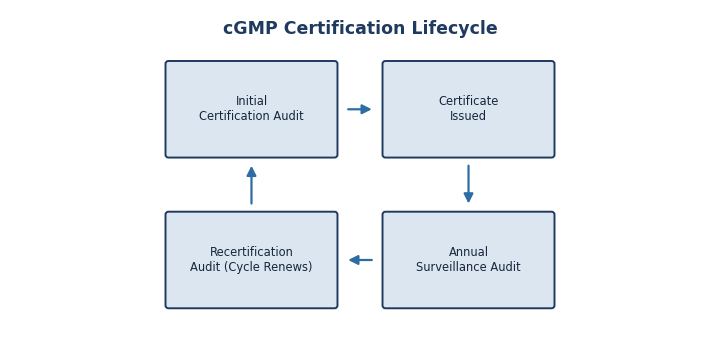
- Annual surveillance — confirms the management system continues to operate as certified.
- Recertification — a full audit at the end of the certification cycle to renew the certificate for a further term.
- Lapsed dates carry risk — a lapsed surveillance or recertification audit can result in suspension or withdrawal of the certificate. Manufacturers therefore typically build these dates into their internal quality calendar well in advance.
- Why buyers value the cycle — a buyer’s own audit gives a snapshot of a single day. A maintained certificate, backed by recurring surveillance, gives ongoing evidence that a supplier’s process controls have held up under continued scrutiny. An unbroken surveillance history becomes part of the supplier’s commercial credibility.
Quick Definitions
- GMP: Good Manufacturing Practice — the collective term for manufacturing quality requirements.
- cGMP: Current Good Manufacturing Practice — the same discipline, but with currency stated as a requirement.
- NPRA: Malaysia’s National Pharmaceutical Regulatory Agency — issues and inspects pharmaceutical manufacturing licences directly; not a third-party certification body.
- Scheme and scope: the specific framework, and the products measured against it, decided at application.
- Surveillance audit: a shorter yearly visit checking the certified system is still in use.
- Recertification: the full audit repeated at the close of the certification cycle.
Explore Related Certification and Training Services
- Product certification in Malaysia
- BRC certification
- Kosher certification
- Green certification
- CE marking certification
- RoHS certification
- ISO internal auditor training
- ISO lead auditor training in Malaysia
- ISO foundation training
- Frequently asked questions
- The growth of ISO certification in Malaysia
Take the Next Step
Overseas buyers, distributors or contract-manufacturing partners may ask your facility for independently verified evidence of process control. An IAS cGMP certificate, scoped to your specific products and applicable scheme, is built to answer that request. There is no obligation to proceed after scoping, and the written quotation covers the full cycle, surveillance included.
Reach out to the IAS Malaysia team on +60 3-2201 5087 to discuss your product scope and receive a fixed written quotation.
Frequently Asked Questions
Is cGMP certification a legal requirement for manufacturers in Malaysia?
cGMP certification from IAS is a voluntary, independent third-party certification, separate from any mandatory licensing for specific product categories. NPRA or the Ministry of Health’s Food Safety and Quality Division require that licensing. Many manufacturers pursue certification to satisfy buyer, export or contract-manufacturing requirements that go beyond baseline regulatory licensing.
If we already hold an NPRA GMP licence, does an IAS cGMP certificate duplicate it?
No, and it does not replace it either. An NPRA licence confirms that a facility meets Malaysia’s pharmaceutical manufacturing licensing requirements. An IAS cGMP certificate is an independent, buyer-facing attestation against a defined GMP or cGMP scheme and scope. Certification never substitutes for an NPRA licence, a product registration or a Ministry of Health food premises approval — many exporters hold both because they answer different questions for different audiences.
How does cGMP certification support Halal and export documentation?
Halal certification and cGMP certification address different questions: one covers Shariah compliance, the other covers manufacturing process controls. Overseas buyers frequently request both as part of the same supplier due-diligence file. Holding an IAS cGMP certificate alongside Halal certification and export documentation gives buyers a fuller picture of a facility’s process discipline.
Can Malaysian SMEs and OEM or ODM contract manufacturers apply?
Yes. Facility size is not a barrier — small and mid-sized contract manufacturers, OEM and ODM operators, and single-product facilities can apply, with the audit scoped to the specific product lines and processes they run.
What happens if the audit raises a nonconformity?
The finding is recorded with the evidence behind it, and the manufacturer proposes a corrective action with a target date. IAS reviews that action and verifies it has worked before the certification decision is made. Depending on the significance of the finding, verification may be done by reviewing submitted evidence or by a follow-up visit, which is why corrective-action follow-up appears as a cost driver above.
Will an IAS certificate satisfy audit requests from multinational buyers?
An IAS cGMP certificate gives multinational buyers and regional distributors independently verified evidence of process controls, which typically reduces the depth of their own supplier audits. Buyers may still conduct scoped audits of their own as part of their internal supply-chain governance.
How do overseas buyers verify that a certificate is genuine and current?
Buyers can confirm certificate validity, scope and status through IAS’s certification search facility, which lists active certificates by company name and scheme, rather than relying on a printed certificate alone.

