Top Industries in Malaysia Benefiting from CE Marking Certification
If your Malaysian business exports products to Europe — or plans to — three letters will determine whether your goods ever reach the shelf.
What Is CE Marking and Why Does It Matter for Malaysian Exporters?
CE stands for Conformité Européenne — French for “European Conformity.”
When a product carries the CE Mark, it tells European regulators, distributors, and consumers that the product complies with all applicable EU directives and regulations. It is essentially a passport — without it, your product cannot legally enter or be sold in the European market.
For Malaysian exporters, this matters enormously.
Europe represents one of the world’s largest and most lucrative consumer markets. Malaysian trade with the EU runs into billions of ringgit annually, spanning electronics, medical devices, machinery, and more. As demand for Malaysian-made products grows internationally, CE Marking has shifted from a niche requirement to a mainstream business priority.
The certification process involves conformity assessments, technical documentation, and in many cases, third-party testing — all of which must be completed before the CE Mark can be affixed to any product.
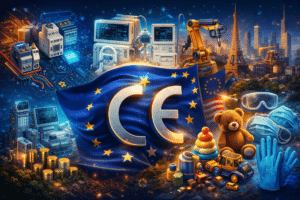
Top Industries in Malaysia Benefiting from CE Marking Certification
Not every product requires CE Marking — but for the industries that do, the competitive advantage of certification is significant. Here are the sectors in Malaysia gaining the most from it.
1. Electrical and Electronics (E&E) Industry
Malaysia is one of the world’s leading exporters of electrical and electronic products. The E&E sector accounts for a substantial share of the country’s total exports — and Europe is a key destination market.
Products like switches, circuit breakers, power supplies, cables, and consumer electronics all fall under EU directives such as the Low Voltage Directive (LVD) and the Electromagnetic Compatibility (EMC) Directive.
CE Marking benefits for Malaysian E&E companies include:
- Market access — Without CE Marking, Malaysian electronics simply cannot be sold in Europe, regardless of quality.
- Reduced customs friction — CE-certified products move through European customs with far fewer complications and delays.
- Buyer confidence — European distributors and procurement teams actively prioritize CE-certified suppliers when shortlisting manufacturers.
For an industry already operating at global scale, CE Marking is the key that unlocks one of the world’s most valuable markets.
2. Medical Devices and Healthcare Equipment
Europe applies some of its strictest standards to medical devices through the EU Medical Device Regulation (MDR). CE Marking under this framework is rigorous — and precisely because of that, it carries immense weight.
A CE Mark on a Malaysian-made medical device communicates one clear message to European hospitals, clinics, and procurement bodies: this product has been independently verified to meet the highest safety and performance standards in the world.
For Malaysian medical device companies, certification opens doors to:
- Long-term contracts with European healthcare institutions
- Entry into pharmaceutical and hospital supply chains that require certified vendors
- A reputation for quality that strengthens positioning in other international markets beyond Europe
3. Machinery and Industrial Equipment
Malaysia has a robust industrial machinery sector — producing everything from food processing equipment and woodworking machines to construction tools and agricultural machinery.
Any machinery exported to Europe must comply with the EU Machinery Directive, which mandates CE Marking to confirm that the equipment meets essential health and safety requirements.
This is a sector where CE Marking delivers particularly clear financial returns. Industrial buyers in Europe operate under strict procurement guidelines — and an uncertified machine, regardless of its actual quality, will not pass vendor approval.
Key benefits for Malaysian machinery manufacturers include:
- Vendor qualification — CE certification is a non-negotiable prerequisite for most European industrial procurement processes.
- Liability protection — Certified machinery comes with documented conformity assessments, protecting manufacturers in the event of product liability disputes.
- Premium pricing power — CE-certified industrial equipment commands higher price points in European markets compared to uncertified alternatives.
4. Toys and Children’s Products
The EU Toy Safety Directive is one of the most comprehensive product safety frameworks in the world. CE Marking under this directive requires manufacturers to demonstrate that toys are free from harmful substances, structurally safe, and age-appropriate in their design.
For Malaysian toy exporters, certification is not just about compliance — it is about trust. European parents and retailers are acutely sensitive to product safety in children’s goods. A CE Mark provides the assurance that drives purchasing decisions at every level of the supply chain.
5. Personal Protective Equipment (PPE)
Since the global pandemic, demand for PPE has surged — and Malaysia emerged as a significant global supplier of gloves, masks, protective clothing, and safety gear.
The EU PPE Regulation requires CE Marking for all protective equipment sold in Europe. Malaysian PPE manufacturers who invested in certification during and after the pandemic found themselves with a durable competitive advantage — certified supply chains that European buyers trust and return to repeatedly.
PPE certification benefits include:
- Sustained European demand — Certified manufacturers maintain long-term supply agreements rather than one-off orders.
- Differentiation from uncertified competitors — In a crowded global PPE market, CE Marking separates serious manufacturers from low-quality alternatives.
- Scalability — Once certified, expanding product lines within the same regulatory framework becomes significantly easier.
What Malaysian Businesses Should Know Before Pursuing CE Marking?
CE Marking is achievable — but it requires preparation, technical knowledge, and a clear understanding of which EU directives apply to your specific product.
Key steps every Malaysian business should take before beginning the process:
- Identify the applicable EU directive(s) for your product category — different products fall under different regulatory frameworks.
- Conduct a conformity assessment — determine whether self-declaration is permitted or whether a Notified Body (third-party certifier) is required.
- Compile a technical file — document design specifications, risk assessments, test reports, and declarations of conformity.
- Affix the CE Mark correctly — the mark must meet specific size and visibility requirements and be accompanied by the correct documentation.
Working with an accredited certification consultant familiar with Malaysian manufacturing environments significantly reduces the time and cost of the certification journey.
CE Marking Is No Longer Optional for Malaysian Export Growth
Europe is not a market Malaysia can afford to overlook — and CE Marking is not a requirement Malaysian exporters can afford to ignore.
Across electronics, medical devices, machinery, toys, and PPE, the companies that have invested in CE certification are winning contracts, building relationships, and scaling internationally at a pace their uncertified competitors simply cannot match.
CE Marking does not just open the European market. It signals to the entire world that a Malaysian business operates at the highest international standard.
“CE Marking does not just open the European market. Visit our main page to explore CE Marking certification in Malaysia and how IAS can help your business comply.”
