ISO 14001:2026 – The Moment Environmental Management Stops Being Optional
For years, environmental standards have guided organizations toward better practices. But ISO 14001:2026 is not just another revision—it is a turning point. It signals a shift from structured compliance to intelligent, real-time environmental governance. This change is not subtle. It is disruptive, demanding, and deeply transformative.
Businesses today are no longer judged only by profit margins or operational efficiency. They are evaluated by how responsibly they interact with the environment, how transparently they report their impact, and how quickly they respond to emerging risks. ISO 14001:2026 captures all of this and pushes organizations into a future where environmental performance is no longer hidden behind reports—it is visible, measurable, and constantly evolving.
This is why many experts see this update as an “eye-opener.” It exposes a hard truth: traditional environmental management systems are no longer enough.
The Real Shift: From Environmental Management to Environmental Intelligence
The most powerful change in ISO 14001:2026 lies in its mindset. Earlier versions focused on building systems, documenting processes, and ensuring compliance through periodic audits. While effective for their time, these approaches were largely reactive. Problems were identified after they occurred, and improvements were implemented gradually.
ISO 14001:2026 replaces this with a fundamentally different expectation—environmental intelligence.
Organizations are now expected to understand their environmental impact in real time. This means continuously collecting data, analyzing patterns, and using insights to predict future risks. Instead of asking, “What went wrong?” companies must now ask, “What could go wrong next—and how do we prevent it?”
- Environmental management shifts from reactive correction to predictive prevention
- Continuous data collection replaces periodic environmental reviews
- Decision-making becomes dynamic and insight-driven rather than document-driven
- AI-powered tools enable faster detection of environmental anomalies
- Environmental performance becomes a live operational metric, not a static report
Artificial intelligence plays a crucial role in this transformation. AI-powered systems can process vast amounts of environmental data, detect anomalies, and provide predictive insights that humans alone cannot achieve at the same speed. For example, energy consumption patterns, emission levels, and waste generation trends can all be monitored continuously. When irregularities occur, systems can trigger immediate alerts, allowing organizations to act before the situation escalates.
This shift is not just technological—it is cultural. It requires organizations to move from static policies to dynamic decision-making. Environmental management becomes an ongoing process rather than a periodic activity. Leadership teams must integrate environmental considerations into daily operations, strategic planning, and long-term investments.
In essence, ISO 14001:2026 transforms environmental management from a support function into a core business capability.
What Makes ISO 14001:2026 Impossible to Ignore?
One of the reasons this revision is gaining so much attention is the depth of its expectations. It does not simply refine existing requirements; it expands them in ways that challenge how organizations operate at every level.
A key development is the emphasis on predictive risk management. Environmental risks are no longer limited to immediate operational issues. They now include climate-related disruptions, supply chain vulnerabilities, and resource scarcity. Organizations must anticipate these risks using data-driven approaches rather than relying on historical trends alone.
- Risk identification must include future environmental scenarios and climate uncertainties
- Organizations are expected to use predictive analytics instead of historical-only data
- Environmental incidents should be minimized through early detection systems
- Supply chain risks must be evaluated from an environmental perspective
- Risk management becomes a continuous, technology-enabled process
Another defining feature is the move toward continuous environmental monitoring. Traditional audits and periodic reviews are no longer sufficient. Organizations are expected to maintain real-time visibility into their environmental performance.
- Real-time tracking of emissions, waste, and resource usage becomes essential
- IoT and sensor-based monitoring systems are increasingly required
- Immediate corrective actions replace delayed response mechanisms
- Data transparency becomes critical for compliance and reporting
- Environmental dashboards enable instant performance visibility
The standard also strengthens its connection with global sustainability expectations. Environmental management systems must now align more closely with ESG frameworks, making transparency a central requirement.
- Organizations must provide clear, measurable sustainability data
- Environmental performance must align with global reporting expectations
- Stakeholders demand evidence-backed sustainability claims
- Lifecycle thinking expands to cover full product and supply chain impact
- Leadership accountability becomes direct and visible
Together, these changes make ISO 14001:2026 more than a standard—it becomes a framework for transformation.
Why Early Adaptation Will Define Market Leaders?
While the requirements of ISO 14001:2026 may seem demanding, they also present a significant opportunity. Organizations that act early can position themselves ahead of competitors, not only in compliance but in overall performance and reputation.
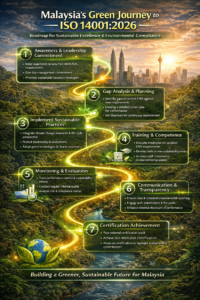
In Malaysia, this transition carries particular importance due to increasing regulatory pressure and global market integration. Companies operating in Malaysia must now align with stricter environmental expectations while maintaining competitiveness in international trade.
Across the regions of Malaysia, organizations are realizing that environmental management is no longer just about compliance—it is about strategic advantage.
- Early adopters gain stronger brand credibility and global trust
- Improved resource efficiency leads to cost reduction and operational optimization
- Real-time data enables faster and more accurate decision-making
- AI-driven insights help organizations stay ahead of environmental risks
- Compliance becomes easier as systems are proactively aligned with new requirements
AI plays a central role in enabling these benefits. With the ability to analyze complex datasets, AI systems can identify patterns that would otherwise go unnoticed. This leads to more informed decision-making, faster responses, and continuous improvement.
- Machine learning models predict emissions and environmental impact trends
- Automated systems detect deviations and trigger instant alerts
- Digital tools streamline compliance and reporting processes
- Predictive analytics reduce uncertainty in environmental planning
- Intelligent systems support continuous improvement without manual delays
Moreover, early adopters are more likely to gain trust from stakeholders. Customers are increasingly choosing brands that demonstrate genuine commitment to sustainability. Investors are directing funds toward organizations with strong environmental performance, and regulators are tightening requirements.
ISO 14001:2026 helps organizations meet all these expectations simultaneously. It creates a structure where environmental responsibility, operational efficiency, and business growth are interconnected.
Final Reflection
ISO 14001:2026 is not just a standard—it is a signal of where the world is heading. It challenges organizations to rethink their relationship with the environment and to adopt a more intelligent, proactive approach.
The question is no longer whether businesses should implement environmental management systems. That decision has already been made.
The real question is whether they are ready to evolve with the standard—or be left behind by it.

